Showing posts with label course. Show all posts

Friday, 2 September 2011

The long and the short of it

I made pastry at the course on Tuesday. With my hands. Using bread flour. It was delicious.

I think it's pretty unlikely that you're reading the above with the same sense of amazement with which I wrote it. I've always found it next to impossible to make decent pastry - the closest I've come is doing the rubbing in in the food processor, but this makes it so hard to get the water right. And even if I did get the water right, I'd then have to handle it and it would transform from pastry into a lump of closely-knit grey stuff.

So the fact that I made pastry with my hands, using strong flour, and that it was delicious is still a source of absolute astonishment to me. Clive demonstrated the method of emulsifying the butter and the water, which we then followed. When I added the emulsion to the flour it produced a pliable, yellow and smooth paste which I handled as if it were Play-Doh and which remained supple and beautifully pale. Clive pinned his out and used it to make jamless jam tarts - just to demonstrate to us the texture and shortness of the finished pastry shells. They were incredible, lovely to eat plain just as they were, short as you like, crisp, wonderful. We took our pastry paste home in our boxes and I stashed mine in the fridge for a couple of days.

I decided that I was going to make biscuits with mine, so I took it out of the fridge and let it come up to ambient temperature. When it was ready to be worked, I zested a lemon onto the worktop then started working the paste on top of it so that the zest was incorporated fully into it. I rolled it out and cut out little circle and star shapes and transferred to a parchment lined tray. I rerolled the trimmings time after time without the paste degrading, and at no point did I need any flour on the worktop. A quick flash in the oven and a sprinkling of sugar and I had the loveliest, lightest, crispest, shortest little biscuits. Which I placed next to Tallboy on the sofa, and which inexplicably disappeared within a very few minutes.

The advantage of paste made with this method is that it is less likely to shrink back or puff up when being baked, which is a relief because in the past, if I did manage to make rollable pastry, I always managed to have it fall in on itself when baking the quiche case blind, with the distressing consequences of quiche filling escaping and pooling in unsuitable places.

This, then, is why I am most excited by this new discovery that I can make pastry, with my hands, even using strong bread flour, which is fantastic and delicious and manipulable and rollable and rerollable and everything. It's magic!


Tuesday, 30 August 2011

Nose to the grindstone

It was a long and busy day yesterday, but brilliant fun. I've been on a breadmaking course with Clive at Shipton Mill, learning new techniques and getting a better understanding of working with flour. He has a great perspective and depth of knowledge, and clearly enjoys sharing this with others, encouraging them and opening them to new ideas and ways of thinking. Six of us gathered at the mill in Frampton-on-Severn, and after a cup of tea off we went, grouped around a large wooden-topped bench and working separately on our own doughs.

To start the day, Clive handed round examples of breads that he'd made by different methods. It was lovely to see him slice them open to reveal the inside, then pass it round so that we could smell it and see and feel the texture. The variety and textures were brilliant to see and compare, and I'm sure I wasn't alone in aspiring to produce something that good as I followed with my eyes each loaf that I passed on.

We started our own baking with a white dough using a sponge (a basic white dough left to ferment and stored in the fridge). Clive referred to the ingredients using the baker's percentage (expressing each ingredient as a percentage of the mass of the flour used). I'd seen this used in various recipes but had found it strange and was reluctant to tackle it, so it was really helpful to see this approach in action. Although it requires a bit of mental agility, it frees you from a written recipe and makes it so much easier to scale your quantities. He also talked about taking control of the process and how you can adapt variables like temperature and added ferments and time to help you to do this.

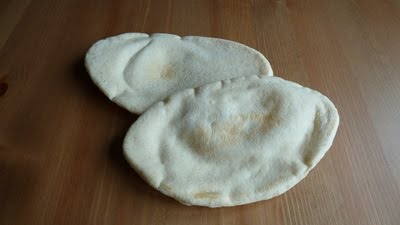
Working this dough involved tearing it, using the heel of the hand to stretch it away along the bench, then rolling it back up again. This was very different to how I'd been working my dough at home but was easy to get the hang of and although I'd been concerned that it would feel like I wasn't incorporating enough air, the rolling back up was certainly doing this. Folding the dough was similar to what I'd learned before, but the moulding action was new to me - with hands flat on the bench, palms up, you bring them in close to each other at the base of the dough, sliding one away from you and one towards you, twisting the base of the dough - creating tension and a neat rounded form. With this dough we made a cottage loaf (my first ever), pittas and a plaited loaf (mine suffered a bit of a collision with the back of the oven as a consequence of some rather overenthusiastic peel wielding). The pittas cooked quickly and elicited oohs and aahs from the group peering through the oven door as our breads inflated beautifully before our very eyes. Pittas are the one bread I still buy in the shops - but not, I think, for much longer...

We made a soda bread with coarse brown flour, sunflower seeds, herbs and feta. These were the first out of the oven, and a collective swell of pride in the room was almost tangible, the results looked so good. Each had a cheeky little paper tag poking out of it to identify its creator. 'So that nobody can disown theirs, ' smiled Clive - but nobody wanted to disown any of them.

The next dough was a sweet dough for Chelsea buns, using a flying ferment to get things going so that the yeast had a chance against the retardant effects of the sugar and butter. This was very sticky work, mixing the ferment and the main dough by hand and squishing in the butter. The proud-o-meter in the room rose a notch or two when those beauties came out of the oven and we finished them off with a quick brush of runny icing.

Finally, we used an emulsifying method of preparing the non-flour ingredients for a sweet shortcrust pastry, producing a paste which could be handled and re-handled without danger of the water and gluten interacting. I think I might finally have found a way that I can make good pastry!

Lunch was a delicious sampling of the breads Clive had shown us first thing, allowing us to compare even more closely the texture, smell and taste. The rye with figs was extremely popular.

Included in the day was a tour of the mill, a fascinating journey from the testing done before a delivery of grain is accepted, to the final bagging and despatch of the sacks.

The last hands on operation before assembling our goodies and making our way home was the feeding of Clive's sourdough mothers - a white and a rye. Once they were snoring after a good feed, he generously gave us a portion of each to take home - so all my agonising about how to get one going for myself was completely unnecessary. Perversely, just before I left for the course, I saw that the starter I'd attempted had caught, and was bubbling happily. With three to juggle, I can see that I've got scope for a lot of experimentation over the next few months, and I'm starting to wonder what happens if you mate a couple...

I had a tiring but brilliant day, learned a huge amount about flour and how to work with it, enjoyed myself immensely, made bread that I'm very proud of, and was once again hugely impressed at how well a good kitchen works. Everything was to hand, used stuff was tidied away instantly, the bench was cleaned and tidied at every opportunity and it all just worked like clockwork. This was in no small way attributable to Washing-Up Fairy Lesley who not only washed and dried but kept us going with tea and lots of smiles.

As I drove home I reflected on the day and the very great pleasure that there is to be had in watching an expert doing what they love - the fluid, assured movements and handling of materials, the unhurried pace and the wonderful results. I loved, too, Clive's clear enjoyment in sharing with others and seeing them grow in confidence and skill.

Big thanks to Clive and Lesley and everyone else at the Mill for a fantastic day full of information, hard work and good humour which has left me happy and proud and with a head full of possibilities.


Sunday, 28 August 2011

Using my loaf

It's for pulling out of the toaster and covering in butter and jam, it's on a side plate, it's there for dipping and nibbling while you choose what you're having, it's the bit that you hold and which holds the filling, it's for scooping up dips and for fiddling with during lulls in the conversation. It's always there, it's a quotidian object; its ubiquity makes it almost invisible.

The session during Richard Bertinet's course where we sat round listening before we got our hands dirty - Richard passed round a bagged sliced loaf bought that morning from a local supermarket, asking us to read out the ingredients, to touch and squish and smell the slices - really started me thinking. Richard, in the most drool-inducing manner described the experience of choosing some French bread in a boulangerie, squeezing it and feeling the crust yield with a gentle crack, breaking off the end and nibbling it. He then talked us through a bog standard sliced bread sandwich - no crust, no crunch, no anticipation, a wet mass sticking to the roof of your mouth, quick swallowing without much chewing. It all resonated very strongly.

I was aghast at the list of ingredients in tiny writing on that plastic bag. I couldn't stop my eyes straying from it to the water, yeast, salt and flour lined up on the worktop next to Richard, throwing all those extras into sharp relief. Never a big fan of the stuff, I would have pittas for my lunch, but I wasn't averse to sticking the odd slice in the toaster. I tried to think of another foodstuff that I'd happily eat knowing that it contained such things. I couldn't.

So why did we buy it every week? Why was running out of it a disaster to be avoided at all costs? I suppose a mixture of habit and convenience. I've not had a very happy relationship with food over the years, but divorce isn't really an option is it? Choosing better what to have a bad relationship with was starting to seem like a good idea. When Tallboy picked me up in the Circus after the course, the first thing I blurted out was that there were to be no more plastic wrapped supermarket sliced loaves. He wasn't convinced, but didn't want to pop my fresh-baked just-out-of-the-course bubble.

I talked to him about a crust that makes you actively chew, and a texture that is a pleasure to eat. I bored him with lists of ingredients. He surrendered. We haven't bought a loaf since the beginning of July. He comes home from work and tells me how much he enjoyed his sandwiches, how good they tasted, how enjoyable it was to eat them, how he actually noticed he was eating them. I've been actually eating bread rather than grabbing a quick slice of toast once in a blue moon. It's part of my daily food vocabulary.

And that's the thing - it's started to be food, not just something to put butter on, or an outside for a filling. It's nutrition, it's tasty, and I actually want to eat it and enjoy it. Every week I make different loaves so we're not stuck on a treadmill of sameness. And every week I make extras - bagels or rolls or fougasses - for us to enjoy. It's stopped being invisible, and it's started to be something we look forward to. It feels great to make something the boys love, and to take the odd little offering round to the Brazil Nut's. Notwithstanding my lameness with a lame and my tendency to over-prove and have catastrophic collapses unfolding before my horrified gaze, I am making good food that others love and I am proud of it. Running out isn't the disaster it used to be, either. I just make some more...

Saturday, 9 July 2011

A day in Bertinet's kitchen

It all started last Saturday. Tallboy dropped me off in Bath at half nine, and I made my way to The Bertinet Kitchen, tucked away just above George Street. As it's on the side of a steep hill, the shop is on street level, and so is the kitchen. It's just that they're different streets. With unerring predictability, I chose the wrong street.

We started with toast and coffee and hello I'm so and so. The group gradually swelled until we were thirteen or fourteen, the boys outnumbering the girls and the vast majority present because they'd been bought the course as a gift.

The session proper started with a discussion about the contents of bread, contrasting those of home-baked bread and supermarket sliced bread. Then followed an exposition of the French method of dough working - the bare-armed baker at his trough, the frasage, the découpage, the passage en tête, the étirage, the soufflage, all magical, mysterious and evocative terms. The contrast with the hammering we're taught to give the dough in this country was astonishing.

Finally, it was time for action. Richard wielded his scraper with virtuosity and showed no hesitation in showing the dough who was boss. I'd seen his method on TV previously - that was what had excited my interest in learning more. It was fascinating to see it close up, but disheartening too, as there was no way I was going to be able to do that - at least not just yet.

The freshly mixed dough was removed from the mixing bowl with the encouragement of the scraper, tidied and tucked in around the edges again by means of the scraper, then scooped up double-handed, the top third being gripped and the rest hanging down towards the worktop. A little flick forwards of the still dangling trailing edge, then a swift slap onto the worktop, the sound of the impact startlingly loud. Now the pulling back of the part still gripped, bringing it over and away in an air-gathering arc, then laying it back down on the part still adhering to the worktop. All along, the same part stays on top - no flipping or turning, just the same movement repeated, with the same piece on top. A quick scrape, tuck and tidy every so often, but mostly just grab, slap, pull and over, the rhythm of the noise almost metronomic.

Within a few minutes, the dough was sufficiently worked and consigned back to its bowl for rising, and then it was our turn. We worked in pairs, which was a little frustrating as I itched to do it all myself and translate what I'd seen into actions, but it was also useful as you had the opportunity to stand back and observe. Getting the hang of the action was hard work, and our lump of dough looked nothing like Richard's. Gallingly, he would come past, see the state of it, work it for a moment and it would look perfect; back in our hands it reverted to a sticky, recalcitrant mess.

Our second (and much larger) batch was more successful, but worked between four of us, so the itching-to-be-doing-it factor was multiplied. The second batch was much easier to work and I finally felt like I had the hang of the grab slap pull and over. Using the scraper became much easier too, trying to take the lump of dough for a walk around the table while keeping the top, well, on top.

More scraper practice with the risen dough - fabrication of fougasses, breadsticks, loaves in tins - then Richard put together two huge trays of herb-laden focaccia. We got to practise oven technique too. The correct approach is one of respect and obeisance - on one knee, you open the door fully, the warm blast merely riffling your hair as it passes over you rather than catching you full in the face and huffing up your specs. Now you can introduce your peel and with a little flourish pull it away, your dough left perfectly on the baking stone, then close the door and leave it to do its stuff.

At last in the baking kitchen it was time for lunch - it had been a hard few hours' work and to sit down and appreciate what we'd made was very welcome. Our produce looked amazing arranged in baskets on the table, and we enjoyed a companionable lunch together.

The only thing left to do was to equip myself with some necessities for my baking at home. I had to get Dough and Crust, both of which Richard signed for me, and a couple of linen cloths, oh and two scrapers. And a pot of delicious sea salt. Sadly while I was queuing up to make my purchases, the communal produce was being shared out - when finally I came to fill my little brown paper bag, all the breadsticks had gone. Still it, was an excuse to make some more the next day - and let's face it, I clearly need the practice...

I left with my head full of new ideas and techniques, marvelling at Richard's effortless prowess, and astonished at the hard work behind the scenes which makes a kitchen work - Kieran seemed to be everywhere, all the time, anticipating Richard's next requirement like a theatre sister ready to slap the next instrument into the surgeon's outstretched hand. I was very impressed. So was Tallboy when he picked me up and saw the goodies I was bringing home with me, although his face fell rather when I told him that Richard said he wasn't allowed to buy any more supermarket sliced loaves.

At the beginning of the day, Richard had told us that we would all now become bread bores. We'd host dinner parties and wait for someone to ask us where we'd got our bread, whereupon our spouse would bury their face in their hands while we launched into bread mode. I rather think he was right...