Showing posts with label mill. Show all posts

Monday, 26 September 2011

All grist to the mill

Today Tallboy and I ventured into Oxfordshire, to go and look round the place that makes the Half and Half bread flour which I love using. I'd spotted on the Wessex Mill website that mill tours were available, and I booked one up to coincide with our day off work. I'd already had the experience of a tour round the larger Shipton Mill, so had an idea what to expect, but this was a first for Tallboy.

We arrived at the mill just before our allotted time and were able to park outside easily. Stepping into the mill shop, we were greeted by an almost dizzying array of flours - I hadn't realised how extensive their range was. I introduced myself and Tallboy as the 11 o' clock tour and we were shepherded through to the back by Paul Munsey, the miller.

Paul started by giving us some history of the business, the mill and the family - all three heavily intertwined. He is a fourth generation miller, his great-grandfather having become a miller in Oxford as Victoria's reign was about to end. The original mill, an image of which is on the front of the flour bags, was in Mill Street, Oxford (opposite the train station) and sadly burned down in 1945. The business then relocated to an existing mill in Mill Street, Wantage (yep, there's a bit of a theme here) with the old damaged mill standing derelict until work started this year on converting it to living accommodation (with a nifty Archimedes' Screw arrangement in the water for the production of electricity). The current building in Wantage (next to the Old Mill) was brought into service in 1980, and is a fabulous warren of busy machinery, steep wooden staircases and multiple levels of activity.

Paul talked about different flours, grains, gluten levels and more about the milling process as we went around the mill, from where the grains are received into the process to the final bagging. He showed us the state of the grist before and after each step, so we had a graphic idea of what was happening and the changes between stages. Tallboy was particularly struck by the sieving cabinets, all suspended on bamboo and moving with a mesmeric action. We were also impressed to see old machinery still living a useful life (some of it had a really old-fashioned encased-in-wood vibe). Paul explained that the machinery they have runs at about half the speed of modern flour rollers, so it produces less heat within the grist.

The final stop was the lab, where the batches of grist are tested and catalogued on the basis of protein content. I'd not heard designations of varieties of wheat before, and was surprised at the rather romantic-sounding names - Gallant, Hereward, Solstice... I was enlightened about the '0' and '00' designation of Italian flour - I'd always assumed it was to do with the strength of the flour, but it's about the degree of processing and fineness of the grinding. Paul also touched on what's involved in getting the product out there to customers, and what lies behind choices they have made about who they supply.

We had a great time - it was fascinating to see the milling process happening in front of us, and to hear about it from someone for whom it's second nature. Paul was knowledgeable, welcomed questions, and was very open in sharing the business with interested customers. What had struck me about the Wessex Mill website was the page showing the grist map - tags show the location and name of the local farms which supply the mill with grain. The backs of the bags flour are printed with the source of the grain, too. It's clear that the mill has a close relationship and dialogue with its suppliers.

The tour lasted for just about an hour, and was very well worth the journey across country. It really makes a difference to see where and how the products you use are produced, and to experience the attitude and knowledge of the people who work there. I won't be able to use my Wessex Mill flour again without picturing the building in Wantage and hearing the mill noises in my head.

Tuesday, 30 August 2011

Nose to the grindstone

It was a long and busy day yesterday, but brilliant fun. I've been on a breadmaking course with Clive at Shipton Mill, learning new techniques and getting a better understanding of working with flour. He has a great perspective and depth of knowledge, and clearly enjoys sharing this with others, encouraging them and opening them to new ideas and ways of thinking. Six of us gathered at the mill in Frampton-on-Severn, and after a cup of tea off we went, grouped around a large wooden-topped bench and working separately on our own doughs.

To start the day, Clive handed round examples of breads that he'd made by different methods. It was lovely to see him slice them open to reveal the inside, then pass it round so that we could smell it and see and feel the texture. The variety and textures were brilliant to see and compare, and I'm sure I wasn't alone in aspiring to produce something that good as I followed with my eyes each loaf that I passed on.

We started our own baking with a white dough using a sponge (a basic white dough left to ferment and stored in the fridge). Clive referred to the ingredients using the baker's percentage (expressing each ingredient as a percentage of the mass of the flour used). I'd seen this used in various recipes but had found it strange and was reluctant to tackle it, so it was really helpful to see this approach in action. Although it requires a bit of mental agility, it frees you from a written recipe and makes it so much easier to scale your quantities. He also talked about taking control of the process and how you can adapt variables like temperature and added ferments and time to help you to do this.

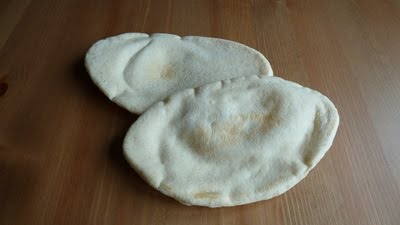
Working this dough involved tearing it, using the heel of the hand to stretch it away along the bench, then rolling it back up again. This was very different to how I'd been working my dough at home but was easy to get the hang of and although I'd been concerned that it would feel like I wasn't incorporating enough air, the rolling back up was certainly doing this. Folding the dough was similar to what I'd learned before, but the moulding action was new to me - with hands flat on the bench, palms up, you bring them in close to each other at the base of the dough, sliding one away from you and one towards you, twisting the base of the dough - creating tension and a neat rounded form. With this dough we made a cottage loaf (my first ever), pittas and a plaited loaf (mine suffered a bit of a collision with the back of the oven as a consequence of some rather overenthusiastic peel wielding). The pittas cooked quickly and elicited oohs and aahs from the group peering through the oven door as our breads inflated beautifully before our very eyes. Pittas are the one bread I still buy in the shops - but not, I think, for much longer...

We made a soda bread with coarse brown flour, sunflower seeds, herbs and feta. These were the first out of the oven, and a collective swell of pride in the room was almost tangible, the results looked so good. Each had a cheeky little paper tag poking out of it to identify its creator. 'So that nobody can disown theirs, ' smiled Clive - but nobody wanted to disown any of them.

The next dough was a sweet dough for Chelsea buns, using a flying ferment to get things going so that the yeast had a chance against the retardant effects of the sugar and butter. This was very sticky work, mixing the ferment and the main dough by hand and squishing in the butter. The proud-o-meter in the room rose a notch or two when those beauties came out of the oven and we finished them off with a quick brush of runny icing.

Finally, we used an emulsifying method of preparing the non-flour ingredients for a sweet shortcrust pastry, producing a paste which could be handled and re-handled without danger of the water and gluten interacting. I think I might finally have found a way that I can make good pastry!

Lunch was a delicious sampling of the breads Clive had shown us first thing, allowing us to compare even more closely the texture, smell and taste. The rye with figs was extremely popular.

Included in the day was a tour of the mill, a fascinating journey from the testing done before a delivery of grain is accepted, to the final bagging and despatch of the sacks.

The last hands on operation before assembling our goodies and making our way home was the feeding of Clive's sourdough mothers - a white and a rye. Once they were snoring after a good feed, he generously gave us a portion of each to take home - so all my agonising about how to get one going for myself was completely unnecessary. Perversely, just before I left for the course, I saw that the starter I'd attempted had caught, and was bubbling happily. With three to juggle, I can see that I've got scope for a lot of experimentation over the next few months, and I'm starting to wonder what happens if you mate a couple...

I had a tiring but brilliant day, learned a huge amount about flour and how to work with it, enjoyed myself immensely, made bread that I'm very proud of, and was once again hugely impressed at how well a good kitchen works. Everything was to hand, used stuff was tidied away instantly, the bench was cleaned and tidied at every opportunity and it all just worked like clockwork. This was in no small way attributable to Washing-Up Fairy Lesley who not only washed and dried but kept us going with tea and lots of smiles.

As I drove home I reflected on the day and the very great pleasure that there is to be had in watching an expert doing what they love - the fluid, assured movements and handling of materials, the unhurried pace and the wonderful results. I loved, too, Clive's clear enjoyment in sharing with others and seeing them grow in confidence and skill.

Big thanks to Clive and Lesley and everyone else at the Mill for a fantastic day full of information, hard work and good humour which has left me happy and proud and with a head full of possibilities.