Showing posts with label sourdough. Show all posts

Saturday, 14 April 2012

The cake of many colours

'Would you like a Herman?' asked the Chief of All the Numpties, all cheerful and pleased with himself. Unwilling to commit to something without knowing anything about it, I requested further details. 'It's this cake that you grow, you feed it and stir it then you cook part of it and give some away and keep some to feed and stir the next week.' I had a dim memory of mum having something like this when we were little, and more recently I remembered my own nurturing of a ginger beer plant, which produced wonderful ginger beer and elevated our weekly sugar consumption to dizzying and unsustainable heights. Enhanced cake consumption would also probably be rather a bad idea, but I quite fancied giving it a go for a bit.

On the Day of Herman Giving, I arrived at work to discover a cheerful orange carrier bag on my desk, and nestling within it a former vegetable soup tub now housing 100ml or so of beige gloop. This was Herman. He was accompanied by a printed note announcing who he was, forbidding his being placed in the fridge lest he should die, and a schedule for his care, cooking and consumption. I pulled the lid back a smidge and was immediately hit with an aroma which combined beer with bakery. Result!

Throughout the day, as I checked on him, I could see that he was growing and growing. After my return from lunch, having forgotten about him, I heard a rustle from my left hand side. I peered across to my next-door colleague but he wasn't there. The noise must therefore have come from Herman. This spooked me just a little bit. Tentatively, I pulled away the carrier. The soup tub was completely full, and the previously flat lid was alarmingly convex. Without thinking, I broke the seal, and with a commendable pop, the buildup of gas within ejected a quantity of Herman over my hands, the bag, and my desk. I may have squeaked in surprise just a little bit. My colleague-in-opposition squealed like a girl, leaped to his feet, muttered in alarm about 'the spores, the spores!' and ran to open a window.

I left him with his lid at a jaunty angle for the rest of the day, and with no further incidents got him home in one piece. I decanted him into a bowl and covered him with a linen cloth, giving him quite the air of mystery and discretion. I introduced him to Junior by telling him that he'd been an only child for long enough and would he like to meet his new brother. He looked alarmed for a second and enquired whether he'd need to share his inheritance with the new arrival; reassured that he wouldn't, he welcomed him in anticipation of baking time next week...

Herman's schedule was based around a ten day cycle. I followed this for the first week but then, not having access to a decimal week, I decided to train him to adapt to a seven day cycle - I can't be doing with baking on different days each week

He gets fed twice a week - one cup each of sugar (I mostly use demerara), plain flour, and milk (I use soya milk). After the second feed he is split into four equal parts: one to keep for next week, one to bake, and two to give away to any willing victim you can find. I have had some success with the Brazil Nut, although she was rather worried about caring for him all week. In the end I pointed out that I can just give her a portion every week and she can go ahead and bake it, and this seemed to her to be an excellent arrangement. If I don't have a recipient for the second giveaway portion, I just make two cakes...

The new arrival


Feeding time at the zoo


All full up


The mixture for my first bake - oil, flour, raisins, baking powder, sugar, eggs and two apples (which I loosely interpreted as meaning 'any old fruit that's lying around and needs using up' which explains why you can see apple, pear and chopped up grapes, one of which looks a bit like a slice of leek but isn't, I promise.


The recipe instructed me to scatter sugar on the top of the cake then to chuck melted butter on before baking. As I would be turning my cake out of the ring mould, I bunged some sugar and butter in the base. Turned out the butter was irrelevant but the sugar has been a constant fixture in subsequent bakes.


Just out of the oven


My First Herman


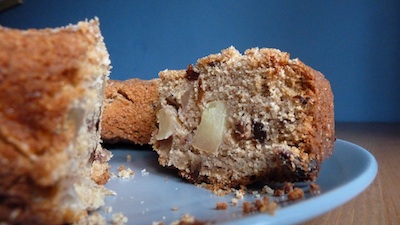
A slice through an apple and cinnamon delight


His second incarnation, banana and blueberry


Number three - coconut, lemon and apricot


Number four - a reprise of apple and cinnamon
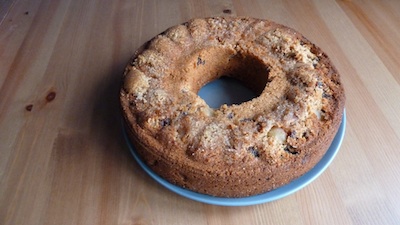


And number five - ground almonds, grated apple, dates and ginger

Saturday, 11 February 2012

Tie your mother down

Let me tell you about my mother. She lives in my fridge and comes out once a week for dinner. The night before a baking session she sits on my worktop all night, then heads back to the fridge again. I know that some take issue with calling sourdough starter a mother, but 1) it gives you the chance to exclaim 'Oh! I must feed my mother!' and 2) I tend towards Clive Mellum's idea that calling it a mother makes it sound kind and friendly and not scary. Because for a while, it all did seem rather scary.

Resolving after my Bertinet day last year not to buy bread again seemed like a big decision and it wasn't without trepidation that I rolled up my sleeves and faced the prospect of the weekly bake. As the weeks went by, I became more confident and more interested in extending my repertoire. Sourdough was the obvious next step but the trepidation levels mounted as I read about the trials and tribulations of creating a starter, casting half of it away, feeding and nurturing it, and finally performing the alchemy of loaf creation. Much of the advice appeared to contradict the rest - type of flour, temperature, quantities, other ingredients, discarding or not discarding. Having informed myself extensively on the internet, I finished up feeling that I knew less then when I knew nothing.

A friend recommended the River Cottage method of creating a starter, so I looked around and found it here. Taking a deep breath, I boiled the kettle and readied my strong white. Not being at all confident how it was going to turn out, I took a note of what I did and recorded how it looked, so that I'd have something to refer to next time.

So, here's what I did.

Monday

In a pudding basin, I mixed up
50g Wessex Mill French Bread Flour
50g Stoneground Rye flour
warm water to mix

I behatted the bowl with clingfilm and left it to do its stuff in the airing cupboard with a whisper or two of encouragement.


Tuesday

As I peeked into the airing cupboard I saw with great joy a bit of a fizz on top of the mixture.

50g of the French Bread flour
50g of the Rye flour
cold water to mix

Again with the clingfilm but I left the bowl on the worktop to continue the process at ambient temperature now that it had 'taken'.


Wednesday

I discarded half the contents of the bowl and decanted the rest into a plastic box with an airtight clippy lid.

100g French Bread flour
cold water to mix

I clipped the lid onto the box and left it on the worktop.


Thursday

Froth-a-rama! I discarded half again (you have no idea of the mess it made in the take-me-to-your-composter box).

100g French Bread flour
cold water to mix

Then back to the worktop.


Friday

Again with the discarding.

100g French Bread flour
cold water to mix

Again with the worktop.

I didn't take a photo this day, so instead here's a picture of a wrought iron flower in the grounds of the Château des ducs de Bretagne in Nantes which I took the week after.


Saturday

Discard.

100g Shipton Mill Baker's No. 1 Strong White flour
less cold water than previously

Worktop.


Sunday

Discard.

100g Shipton Mill Baker's No. 1
less cold water to mix

And now the starter moves to its new permanent home, the top shelf of the fridge, where it lives during the week and is woken, like a fairy tale princess, every Friday ready for the weekend's baking.


Worktop.


If you're thinking of starting a starter or mothering a mother, then I urge you to just give it a go. It doesn't always work but it's easy enough to do it again. I keep my three mothers in the fridge and feed them weekly, it's not at all onerous or difficult and every weekend I make the most amazing bread with them. Huzzah for mothers!

Sunday, 5 February 2012

It's all Greek to me

It isn't easy to bake when you've taken a Porsche to the right knee. Prolonged standing is a no-no for a start. And with limited mobility, fitness just seems to evaporate, so all of a sudden kneading a batch of dough is exhausting. It's been frustrating having my capabilities limited but huzzah for healing and being able to stand up and so on. To celebrate being able to do more, I tried something new.

During my enforced sitting-on-my-arse-on-the-sofa-for-several-weeks period, I got a bit trigger happy with the 'add to basket' button and took delivery of a bunch of books, mostly to do with cooking. The most substantial tome is one simply called 'Vefa's Kitchen' by Vefa Alexiadou ('the Greek Delia' according to my source in Athens) and not only does it require a minimum of two hands for lifting, it is unique amongst my cookery books as it is furnished with a full three place-marking ribbons.


Vefa's book does contain a substantial number of chapters devoted to cooking deceased creatures, but is far from being a dead loss as there is plenty to excite a veggie too. The first place I turned to was the bread section, where I was interested by a recipe which required a hit-and-miss process of leaven creation using chick peas.


The deal is that you mess around with some ground up dried chick peas, introduce them to some boiling water in a jar, wrap it in a blanket and leave it somewhere warm for a day or two then see what happens. You're not to mention to anyone that you're doing it else they might put the evil eye on proceedings and scupper your efforts. I had to tell the boys, though. They don't normally go into the airing cupboard as a rule, but you can bet your bottom dollar that if I hadn't said 'That fermenting jar wrapped in a blanket in the airing cupboard, you see, that one there, touch it and feel my fury' they would have been investigating and probing and rescuing it for me.


The bread is called εφτάζυμο (eftazimo) and this caused me a bit of head-scratching because according to some sources that means '7 times kneaded' and according to others it's a corruption of 'self-leavening'. I prefer the latter...

The first difficulty I had (if you don't count the fruitless search for the box containing my Kilner jars which I'd put away as I never use them) was how to coarsely grind half a lb of dried chick peas. They are hard as little bullets and would have taken chunks out of my food processor blade. They'd probably have demolished my feeble little pestle and mortar too, had I been crazy enough to use that. My only course seemed to be my little coffee grinder which has never seen a coffee bean in its life but which makes short work of linseeds and so on. I divvied up the chick peas into little batches and started to zap the first lot. I don't know if you've ever tried to coarsely grind dried chick peas in a coffee grinder, but if you have, you'll know what I quickly discovered - that instead of an even grind, I managed to produce an astonishing array of items on the continuum

whole unscathed chick peas --------------------- finely powdered chick peas

calling at every station in between. Not being entirely sure what a coarsely ground chick pea looks like, I decided to pretend that this was a desired outcome on the basis that they were all probably coarsely ground on average.


I sterilised my newly-purchased Kilner jar by sloshing boiling water at it, then added my averagely coarsely ground victims, a quarter of a teaspoon of salt and three cups of boiling water. A quick stir with my longest spoon and a momentary oh-lord-my-hand-is-stuck then it was on with the swaddling and tucking it away in the airing cupboard. The coldest weekend for a long time might seem to be a strange time to be undertaking something which needs to sit for a day or two in a very warm place, but we have had the heating on quite a lot...


I peeked after twenty four hours and it seemed to correspond with the description of a deep layer of foam on top. The dreaded 'if there's no foam and it all looks a bit orange just tip it away' scenario hadn't hit. Perhaps the silver coating on the inside of the airing cupboard door has anti-evil eye properties? I brought it downstairs to spoon off the froth but realised as I dunked the spoon that the froth contained a goodly proportion of tiny bits of overground chick pea. Ah. As I pierced the top layer, the fermenting pulses fired a plume of spume, good white bubbles with no bits of chick pea in it. Er, maybe this was how it was supposed to be? I spooned out all the froth, both white and full of chick peas. The steeping juice was also required, so I sieved this into my bowl too, then realised this was a more appropriate technology for the froth so after a bit of juggling back and forwards, I ended up with a froth/juice mixture with a negligible chick pea content.


A cup of strong white flour and a tablespoon of sugar turned it into a slack paste and phase two was go. A plastic bag hat then overnight in the airing cupboard as it bubbled away happily to itself.


In the morning I rescued it and peered worriedly at it, wondering if it was ok. The smell wasn't unpleasant, but was pretty strange and not at all like the sourdough starters I'm used to. A house guest who arrived just after I retrieved it enquired with a wrinkled nose what the hell was that smell.


I went ahead and followed the rest of the recipe, adding the starter to more strong flour, sugar, olive oil, a little salt and three quarters of a cup of water. The resulting dough was very tight, but not knowing how it was supposed to be, and following my usual procedure of sticking closely to a recipe the first time I use it, I didn't make any adjustment.


I left it to prove in two portions in my medium round bannetons, which in retrospect was rather over optimistic as there was little evidence after two hours of any increase in size. I think the leaven was ok, but the dough was just so tight it had no chance. Or maybe the evil eye struck after I took phase two out of the airing cupboard...

I went ahead and baked them anyway, and they produced two squat loaves of a density I don't think I've ever seen before. Sampling a slice with our house guest, we decided it was quite tasty but the texture was off putting. 'You could slice it and dry it out in the oven,' said the house guest. 'It would make fabulous biscuits.'


So I did. Now, instead of two dense loaves with their own gravitational fields, I have tooth-defying dry slices of former loaves, each with such density that they appear to be forming their own galaxy in the storage tin.


Over the next week I shall be grabbing every Greek person I can talk to so that I can enquire earnestly into the right texture for eftazimo. And I'm going to have another go with more water, because the taste was lovely (although quite sweet, with a total of 4 tbsp of sugar in the whole recipe, might cut that down a bit next time). Wish me luck avoiding the evil eye...


Sunday, 6 November 2011

Today's batch

More sourdoughs, unleashing the power of my three mothers simultaneously. In this endeavour, I was given enormous help by the spare sideboard we were given in July, and which used to live in the garage, providing a home for extra tins of stuff. And beer. As mum was bringing down her old kitchen cabinets for us, we needed to remove the sideboard to make way. I dithered about where it should go, until it struck me that if we removed the legs, it could sit happily underneath the long worktop in the kitchen in front of the radiator and furnish an extra work surface which would be ideal for bulk fermenting and proving dough. It made a huge difference. And it's somewhere to stash my bread making kit.

With mother A (Clive's white flour mother and the more sluggish of the three) I decided to go for a white flour loaf with ground seeds. Mother B (Clive's rye flour mother and the liveliest of them) was destined for a Price's bakery rye/wholemeal/white flour dough, and mother C (my own dear creation, and of middling liveliness) was to grapple with a 50/50 spelt/white flour dough.

I fed them all the morning before, and made the dough that evening with a reduced mother content so that they could bulk ferment overnight. I didn't stint with the water this time. They were all very happy sitting under the worktop, and I gave them a fold and a further two hour rest at lunchtime, then a final mould. Those which didn't prove in a banneton I shaped and placed on my thick Stellar baking trays which I intended to place directly on the granite slabs in the oven, thus hopefully avoiding last week's soft bottoms.

I was really pleased with all of them. All rose nicely, baked beautifully and were delightfully firm of the bottom. The holey texture is back (although it could have been holier) and the taste of each was amazing. We had all three breads (and an unpictured Tiger loaf) on the table for dinner, the Brazil Nut and the Cossack joining us for a hugely convivial evening. All drew plaudits and approval; the spelt loaf was the first to disappear.

White with seeds


Rye/wholemeal/white


Half spelt

Saturday, 29 October 2011

Today's batch

Last weekend I realised that I needed to get a new sack of strong white flour as I was scraping the bottom of the barrel with the current one. During the week I called up Shipton Mill and paid for a fresh 25kg sack, then popped up to fetch it from Frampton during my lunch break on Friday. I wobbled upstairs with it over my shoulder when I got home and stashed it in the Flour Storage Area (spare spare bedroom). As I wrestled it into position, I tried to think how long I'd had the old one, but couldn't quite remember. It was only later, when I came across the first invoice, that I realised that I'd used up 25 whole kilos in the space of eight weeks. I know I've been a busy baker but this did surprise me. Let's see how long the new one lasts...

Today I decided to go for sourdough with a vengeance, making a couple of loaves from each of my three mothers. I also chose to try out a couple of new flours from my stash.

First dough was Peter Cook's recipe for a rye-ish sourdough loaf and which I've done before. I used some Wessex Mill wholemeal rye for the first time in this. The dough was quite firm and easy to work. As with all the loaves this time, I left them to prove free form on the worktop, no bannetons this week.

Second dough used a white sourdough mother with Bacheldre Mill oak smoked. I picked this one up out of interest and wasn't at all sure how it would come out and whether the smokiness would compete with the sourdoughness or whether they'd work together. I stinted a bit on the water for this one as I've become very wary of proved loaves collapsing on turning out/slashing and this doesn't seem to happen with less-hydrated doughs. However, I've lost my lovely holes too. I think I need to be brave enough to hydrate fully and take care not to over prove.

Third dough was another white sourdough mother with half Shipton Mill Baker's No. 1 (new sack vintage) and half Wessex Mill wholemeal spelt. Again I was a bit reticent with the water.

I left all the dough to bulk ferment for five hours, then proved for an hour and a half/two hours ten minutes depending on where they were in the queue for the oven. They all proved nicely and were easy to lift onto the peel, no collapsing today. I slashed each type of dough differently so that I could identify them with confidence afterwards, and today I was really pleased with the slashing, it came out really nicely.

I baked one loaf on the top shelf with two on the bottom, and to avoid too dark a crust I tried turning the heat down by ten degrees after fifteen or twenty minutes, turning the top loaf around by a hundred and eighty degrees as I did so. The top loaf still was much darker than the bottom ones both times, and the bottoms of all the loaves were quite soft. I don't know if this was because of the lowering of the temperature, or because I chucked a thick layer of semolina on the worktop when I left them proving so they wouldn't stick, and this got in the way of the dough making proper contact with the granite in the oven. More tweaking required...

As you'll see in the pictures, there were no proper sourdoughy holes in the loaves, so although they looked great on the outside (and they are yummy), there is still work to be done. And I'm not getting the temperature/length of bake quite right. I'd like them to be beautifully done but not so dark. I wonder is this the penalty you get with a fan oven?

The rye-ish one is delish - that recipe is a reliable one for producing a tasty loaf. The oaky smoky one tastes very smoky to me, but not at all to Tallboy. It's not an unpleasant taste, but it's a bit of a surprise. I think it would work best in a bread that you'd eat with some strong cheese or a hearty soup. The spelt loaf is very tasty indeed, although I chickened out and went down the half and half route. I'll have a go at a 100% one again at some point. Probably.

My day's work


Oaky smoky sourdough


Rye-ish sourdough


Half spelt, half not spelt sourdough

Tuesday, 25 October 2011

Today's Batch

Having said that we had plenty of bread and that I didn't need to make any more, I then went ahead and made loads. I think I felt a bit sorry for my poor shunned mothers. Or something.

I got a bit of an itch to try tiger bread too. Though it looks reticulated to me, not stripy as such. Anyway, I did a lot of searching online until I found a recipe I liked the look of, then based things on that (it was here, in Sandra's Cookbook). I did without the sesame oil and just used the recipe for the topping rather than the bread itself. The topping is yeasted, and you have to leave it to mousse up while the dough is in bulk ferment. Once you stir the topping it falls back to a batter kind of consistency, which I applied half way through the prove. This bread was a big hit with the family and with the Brazil Nut who was the beneficiary of one of the three loaves.

Peg got back from the States a few days ago and ordered me to make her a caraway seeded sourdough. And it was mum's birthday, and not able to think what to get her, I decided to make her a stollen. And then there were other sourdoughs to make while I was feeding my mothers...

I decided to do a feed before bedtime and an ambient bulk fermentation, but because I was a bit more organised than last week I fed the mothers nice and early so that I was able to start baking at 8 and didn't spend the whole day at it.

The normal sourdough was mostly white flour with the end of a packet of Half and Half in it. I held the water back a bit too, because dough I've made with that mother in the past has always turned out too loose.

The caraway seed sourdough was from a recipe in Andrew Whitley's book - it used a rye mother, some white rye flour, some Half and Half and some white bread flour. The smell was amazing and I couldn't wait to cut into the bread to see its texture but as it was for someone else I had to restrain myself. But I took my camera to her house so that I could sneak a snap if she started on it while I was there. She did, and I got a taste too - delish and definitely a do-it-again!

The stollen was another of Andrew's recipes, and I spent most of the time referring back to the recipe to convince myself that I'd used the right amount of ingredients as the lump of dough seemed pitifully small. It was right, and it all turned out right in the end, even though I didn't have any ground almonds. I did have some flaked almonds and a coffee grinder which only smelled a bit of curry spices. The marzipan was pretty sticky but this seemed to work well within the stollen as it merged into the adjacent dough. I soaked the fruit overnight in a combination of Cointreau and cherry liqueur which worked really nicely, and I substituted dried apricots for the candied peel he specifies. There's something horrid about candied peel, I'm ok if I know it's there and can pick it out, but if it catches me by surprise it renders every subsequent mouthful a) a minefield and b) tainted anyway by that ghastly, pervasive and revolting taste. The recipe didn't call for any spice and was very nice without, but I might be tempted to add a spot next time.

I clearly still need a bit of help with my slashing and shaping. The white sourdough was a much firmer dough than usual and I was far happier with it. It rose nicely in the banneton and turned out without deflation. I made several slashes along the top but only in one direction, which I think was my undoing. The boule I made from the rest of the dough I slashed in a a curved spoke type manner but I did it half way during proving which I think was a mistake. The top of the loaf looks lovely but sadly the slashes didn't allow enough escape and the loaf suffered a tectonic consequence...

Grrrrrrrrrrrrrr


Hmmmmmmmm...


White sourdough


Rye caraway seed sourdough


Lovely peel-free stollen