Saturday, 10 March 2012

No, not like the Italian dictator...

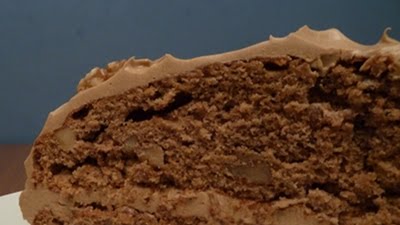
This week's first-time-make was a cream mousseline topping and filling for a coffee and walnut cake. Delia told me to do it.

Tallboy had watched Masterchef yearningly the day before and having seen a parade of patisserie, had evinced a deep longing for a coffee and walnut cake. He then buggered off for the day to give me space to roll up my sleeves and get baking. Indeed, he timed it so well that just as I heard his key in the lock, the oven started beep-beep beep-beep beep-beep to tell me to get the cakes out.

As I had doubled up the cake mixture, I decided to double up the topping/filling too. It seemed only fair. The trouble with doubling things up in your head isn't the simple things like using 120g of sugar instead of 60g. It's when you try to get clever with tablespoonsful and translate them into ml and then into other measurements. Being lazy, I'm not keen on repeated small actions. I'd rather do a single action. That's why I wrote all that code at work, so that I could achieve in a single click what it would otherwise take minutes or even hours of clicking to do. So if a recipe wants 4 tablespoons of something, a quick multiply by 15 gives me the total ml, then I wrestle the appropriate cup measure from the hook and Bob's your uncle - a single measurement. I needed 4 tablespoons of water, 4 x 15 = 60ml. Except of course that I was doubling up, so make that 8 x 15 (or 4 x 15 x 2) = 120ml or half a cup measure. Brilliant. So when I go to make the sugar syrup, I have half a cup of water in my brain. I mean the idea of using half a cup of water, not hydrocephalus. Right, one half cup of water into my pan, and then another, because I'm doubling up, right?

My second deviation from the optimal was employing my old sugar thermometer. There's nothing wrong with it, it has been my trusty friend for decades. But it was a small pan, and the liquid wasn't very deep so the bulb wasn't covered. And I had to identify a temperature of between 103 and 105 °C, an operation which involves a fair bit of squinting and face-screwing-up. Had I thought about it instead of reaching automatically into the drawer for the old-fashioned kit, I'd have used my super duper digital thermometer with the probe.

The sugar syrup needs to boil gently for ten to fifteen minutes until it reaches the right temperature. At about minute 14 it suddenly struck me that I'd used too much water and that I needed to ditch this batch and start again. A further 15 minutes down the line, I was squinting through the steam and deciding that the temperature was approximately between 103 and 105 °C and this surely would be ok.

The trick was now to pour the syrup onto the egg yolks in my mixing bowl in a continuous stream while I carried on whisking with my other hand. As I poured and continued and whisked, the mixture seemed dreadfully thin and not at all cake-coating consistency. In fact, I put the pan down for a few seconds so that I could go back to Delia to check that it was actually yolks I needed - had I managed to get an Italian meringue dreadfully wrong? Delia told me that it was yolks and to get on with it.

Now I pinched bits off the unfeasibly huge amount of butter I had weighed out and whisked them in. With my right arm wilting, I decided to apply the right kind of technology and brought my electric whisk to bear, which made things much easier, but the consistency wasn't changing any. *pinch* *drop* *whisk* Is this right? *pinch* *drop* *whisk* This can't be right *pinch* *drop* *whisk* I'm just going to do a buttercream when I abandon this *pinch* *drop* *whisk*

All the butter was now in the mix but there was no way that it was going to cover the cake for more than a second or two before it succumbed to combination of gravity and its own low viscosity. I kept the whisks going while I leaned over to scan the recipe again. Yes, I'd included what was required, and done what Delia said. Maybe the temperature hadn't been quite right. Maybe I could do with reading glasses nowadays. Maybe I'd been right the first time with the water. I turned back to the sloppy contents of the bowl and regarded them idly as I wondered what I should do. It was then that The Miracle happened and all of a sudden I had a workable cake topping in front of me. For a moment I thought the mixture had split or something similarly awful had come to pass, and turned the whisks off. I realised that all was ok and bunged in the coffee quickly before it changed its mind. A further tentative whisk and I had a perfect coffee-coloured and -flavoured cream for my cake.

I filled and topped (and sided) the cake, perching some half walnuts on top for a hint at the contents. The bowl scrapings were delish - very creamy but light and not too sweet. I was really impressed and very happy with the outcome, and glad that I'd kept whisking beyond what I'd thought was a sensible point.

Offering a slice to Tallboy, I tried to explain the trials I'd been through to satisfy his craving. I told him that I'd never done this kind of topping before, not a standard buttercream but a mousseline. "Oh," he said through a mouthful of crumbs, "like the Italian dictator?"

Tuesday, 6 March 2012

Beware of Greek bread that doesn't lift

I am determined not to be beaten by this eftazimo. I will make some that turns out all right. I might be 90 by the time I manage it, but I will.

I decided to try Vefa's recipe again, but this time to go for a much looser dough. I achieved that, at least. Much, much looser...

This time I was excited to use my new, specially-purchased-for-pounding-chick-peas pestle and mortar. It's huge and solid and spectacularly therapeutic when it comes to crushing the innocent. It's an absolute monster, weighs half of what Junior did when he was born, and was going to be much more fun than the coffee grinder. With not much effort, the chick peas crumbled at my knees. Well, they split in half and discarded their skins. On the downside, I had to be very precise when attacking them, and give each one its own doink - It's pretty impressive how far a mis-hit chick pea can ricochet round the kitchen. On an entirely unrelated note, stepping on a partial chick pea in stocking feet is not an experience one wishes to try more than once. Or even once, really.

I was left with mostly-in-half chick peas, which I decided was probably ok. I put them in my kilner jar with some salt and boiling water, wrapped it in a towel and left it in the cosy airing cupboard for 25 hours, having alerted the boys that it was meant to be there and didn't need rescuing. After its sojourn in the airing cupboard, the jar showed evidence of extreme activity although the froth that was left wasn't much to write home about. It had clearly risen very high up the jar in a desperate attempt to escape its fate, so I am sorry I didn't peek earlier and rescue it then.

I decanted the froth and the juice and mixed it with a tablespoon of sugar and some of Shipton Mill's finest. Something made me put it in a bigger bowl than last time. A plastic hat, then back in the airing cupboard with it. I did peek this time, just before bed, and saw to my horror (ok, deep joy) that the stuff was almost fermenting its way out of the bowl. I scooted downstairs and decanted it into a bigger one to make sure it couldn't escape. In the morning, it didn't look much different, it hadn't grown any and if anything had fewer bubbles. I think I missed the bus on this one again.

The next morning I wasn't ready to use it, so I gave it a spot of breakfast to keep it going and then made up the dough later on that afternoon. I was more liberal with the water this time and in complete opposition to the tight little mass I made last time, I had the sloppiest slappiest dough which I worked the Bertinet way because there wasn't anything else I could do with it.

I left it to prove in a couple of round bannetons in front of the radiator. I watched it like a hawk but couldn't see any movement apart from when one blew a huge bubble at me in a sticking-out-its-tongue fashion. I decided to bake one on a granite slab in the oven, and one in my smaller dutch oven. Neither of these turned out to be a particularly good idea. The one on the stone spread and spread and didn't look like it would ever stop. 'Pancake' is what came to mind as I peered forlornly through the oven window. The one in the dutch oven didn't fare much better.

Again it has been popular with the boys, so it's not a dead loss. It's just galling that getting the chick peas fermenting seems from the write-ups to be the difficult bit, and that is happening for me. It's what I do afterwards that is drenched in fail.

Next time I am going to be guided by Paula Wolfert so you never know, I might have something neat to show you then...

Behold the power of my granite monster


I'm not sure this adds a great deal, I just quite liked the photo


It didn't seem to smell as weird this time. Maybe I'm getting used to it.


Conclusive evidence of an attempted escape


This wouldn't look any different in 3D


The one on the right looks like a cross between a drop scone and a dodgem car


A valiant attempt at bubble formation

Friday, 2 March 2012

A right pair of Herberts

Last night saw another trip to Bath to see foodie people at Topping and Company . My previous visit was to see Dan Lepard talking about Short and Sweet; this time it was two for the price of one with the Fabulous Baker Brothers putting in an appearance.

The shop was extremely full and although I arrived at the billed door-opening time, there were only really spaces at some distance from the speakers. I chose a seat in the back row which gave me space to stretch out my poorly leg and left my bag on it while I headed to the till to pick up my copy of the book. On my return I found a woman sitting happily in my chair, having stashed my bag some way under a table. I struggled to bend down to retrieve it and took up another seat, rather bemused.

The brothers were introduced and Tom spoke widely about a range of subjects, allowing Henry to interject on occasion (in between batches of pancakes). Fortunately, the chaps' voices carried all the way down to us at the end, although this wasn't the case for some of the questioners at the end. Tom talked about all sorts: the origins of Hobbs House bakery, the Herbert baking dynasty, his own career as a baker, his dad's record-breaking achievements. Oh, and bread. Henry talked about being banned from stuff, his career as a chef and latterly as a butcher (not quite so gripping from a veggie point of view, but I knew the score when I bought the ticket), and they both talked about the Channel 4 series and the book, which was produced in a miraculously short turn around time.

The brothers clearly share great enthusiasm for food in general and bread in particular, and work well as a sibling double act. Henry produced an enormous double stack of sourdough pancakes which elicited loud cries of 'Ooooh!' when periodically held aloft. At least they did after the crowd was coached to respond thus in true pantomime style. Tom and Henry both spoke entertainingly and welcomed questions which they answered readily. I couldn't always hear what was being said as the four women in the row in front kept up an unselfconscious conversation for the latter part of proceedings - for the second time that evening my unerring sense of where to sit had struck gold...

When the talking and questions were over, the boys adjourned to the far end of the store for signing, and I shuffled to the end of a long queue of signees. The queue didn't move very fast as the boys took time to talk to everyone who approached them, and (as I discovered as I got within sight) to practise the impressive art of synchronised defacement of the books presented to them. When my turn came, I presented my book and Tom stood up to greet me and shake my hand in a very gentlemanly manner. When I divulged that I had worked at Hobbs House in Chipping Sodbury for several weeks one summer when a student (an awfully long time ago now), he raised my still captive hand to his lips. (I didn't do anything interesting at the bakehouse, just cutting up cakes in trays, but it was fun and you got to see mysterious bread making stuff going on, as well as the juddering shuddering bread slicing machines which always looked to me like they were waiting for the opportunity of snagging your cardie and drawing you, screaming, into their slavering maws.) In the meantime Henry had commenced defacement and upon learning that the book was to be a gift, took it all in his stride and redoubled his efforts.

The book itself is absolutely packed with recipes and tips, and I am pleased to have got one to give to someone special, although the dead stuff:other stuff ratio is a bit too high for me to feel it's a good addition to my mainly vegetarian cookery library. I had a great evening listening to the lads and it was a treat to meet them and see their obvious pleasure in sharing their enthusiasm. There's clearly a lot more to come from them as artisans in their chosen fields, participants in the wider Real Bread movement, involvement in community projects and no doubt further appearances on screen and/or in print. Whatever's in store, I am sure they will rise to the occasion...


Saturday, 25 February 2012

One banana, two banana, three banana, pear

I'm on record as favouring my bananas on the crunchy side. The less green and more brown they get, the more they veer into Tallboy's territory. So it was an easy decision on my part (at the behest of the boys from Bath) to take the last three spotty brown bananas in the fruit bowl and use them to make some banana bread.

This morning the postman knocked on the door and handed over a soggy padded envelope containing a bottle of something which had leaked all over the place, and an amazing Amazon package which contained a new book which had not leaked at all. This lack of leaking is only one of the many things to recommend this freshly-published book, "The Bread Revolution" by Duncan Glendinning and Patrick Ryan (the chirpy chappies from The Big Bread Experiment which aired last year).

The book is packed with photos, some to give context, some a bit of atmos, some for guidance and some just for the hell of it. I particularly liked the beardnet and the duck with a halo - my favourite image of all was the shot of the well-used loaf tins on the rack at the beginning. Despite all the pictures, the pages don't feel too busy and the recipes are well set out with plenty of thought put into their presentation; I couldn't find a point where you'd need to turn the page while you were in the middle of a recipe apart from the particularly detailed everyday white loaf walkthrough. The style of writing is accessible and clear, and quantities are given in a variety of formats. Where yeast is an ingredient, quantities are given for both fresh and dried (it's always been a bugbear of mine where only one type is given - if you're not a confident baker you can feel precluded from trying something if you don't have the right type and aren't sure how to convert).

One of the helpful things the thoughtful bakers have done is to reassure you at various points about the texture of the dough or about what's happening, which is so useful when you'd otherwise be staring down at the bowl in front of you and wondering "should it look like that?" or "should it be doing that?". There are also asides about how you could make changes. I liked the way that they've paired up many of their bread recipes with a meal recipe on the next page, so that you're not making your bread in isolation but can pair it with their suggestions or be inspired to come up with something yourself. They've also given signposts to suppliers (most of which are my faves too), talk about tools and discuss the delights of foraging. This is very much a book about real bread by people who care about it, but it's also not just a book about real bread.

So, banana bread. Well you've got to make something when you get a new cookery book, and I'd been eyeing the daily enbrownment of those bananas with despair for a little while, so it was an easy choice.


I'm also on record as saying I never make changes to a recipe I'm doing for the first time. Except sometimes I need to. Like today. In fact, this is possibly the most non-following following a recipe I have ever done.

For a start, I needed four squishy bananas. There were three in the fruit bowl. I nipped over to see if the Brazil Nut had any lurking in hers. "What, dark squishy ones? Yeah, I had a few. No one would eat them. I chucked them out last night..." OK, what would take the place of a squishy banana? How about the squishy pear which was the only other inhabitant of the fruit bowl? Go on, then. Ah, no pecans. No walnuts, either. OK well how about we go for a full-on squish experience and soak some sultanas in orange juice for a bit - who needs crunchy bits?

Plain white flour? Nah, I reckon I'll use my precious Fattoria La Vialla wholemeal - the mashed fruit looked pretty wet, and wholemeal can cope with a bit more moisture. Golden caster sugar? Nah, I'll just use the normal stuff in my jar with the vanilla pods stuck into it. Milk? I've only got soya milk, that will have to do. Two 1lb loaf tins? I haven't even got one 1lb-er. I'll stick it in a 2lb-er and bake it a bit longer then...

I mixed up my ingredient approximations as directed in the recipe, making a sticky cookie dough-like mess, then added my mashed nanas n pear. Oh, and the drained sultanas. This turned it into a much more recognisable cake mixture consistency which I shovelled into the liner in my tin and bunged in the oven, marvelling at how quickly it heats up when you're needing cake temperature compared to bread temperature.

I gave it 20 minutes longer than directed and left it to cool on a rack while the most delicious scent filled the house. "That smells nice," is what Tallboy's mouth said, while his eyes intimated an immediate and frenzied consumption of the whole thing.


The end result is delish - moist, banana-y and decidedly more-ish. I'm going to have another slice while I leaf through the book again...

Tuesday, 14 February 2012

Your starter for ten

I did a terrible thing the other week. I was standing at the counter feeding my hungry mothers ready for the great sourdoughing session the next day according to my normal practice. I have a little routine to the feeding - with three of the hungry little devils I need to have some set order or I get horribly lost.

I take the mothers out of the fridge and put them in a row on the worktop. I fill and boil the kettle. I go and fetch my tub of rye flour and my tub of strong bread flour. I get out my scoop. I hunt around for my little plastic pot with the dishwasher salt in it which weighs a total of 154g, a figure which by no coincidence at all is exactly the same as one of my mother boxes sans lid. I fill my jug up with mostly cold water and a good slosh of kettle hot water, and that's me ready.

Take the lid off the first mother box. Tare the scales using the little pot, whip it off replacing it, Indiana Jones style, with the delidded mother. Take note of the weight of the contents. Work out in head how much mother I'll need the next day. If adding a third of the mother's weight in flour will exceed my requirements, then bung in a third of my mother's weight in flour. If it won't exceed my requirements, dither while working out in head how much flour to add to bring mother to a quantity suitable for my needs with some left over to blup in the fridge for next time. Add about that much flour. Take off the scales and place on the worktop next to its lid. Slosh into the box sufficient water to allow mixing to the right consistency. Mix to the right consistency.

Repeat the process with the second mother.

Repeat the process with the third mother.

Relid and leave mothers in a row on the worktop to froth and bubble overnight.

That's the plan, anyway.

Where it goes wrong is when you're not paying attention to which flour you're using. Remember we got out two tubs. Imagine you're on automatic pilot when feeding the first mother, working out quantities in your head and so on. In goes the flour. In goes the water. Mixmixmixmix mixmix mix mix m i x m i x m i x m i ...

If you've three mothers, two of which need fed with wheat flour and one of which needs rye, and you just reach for the wheat flour and feed the nearest mother, the odds are pretty good that you've fed a wheat mother with wheat flour. Unless you're me, that is.

Aghast, I surveyed my replete rye mother which had, for the first time, tasted wheat. Now in many respects this wouldn't be too much of a disaster. It would quite happily feed on the wheat flour and be ready the next day as usual. But I had just polluted my 100% rye mother. The 100% rye mother that I use to make loaves which I sometimes give to my wheat free colleague. I decided then and there that she had to go. I'd let her ferment overnight, use her all up tomorrow and then that would be it. Not such a drastic course of action in the light of the backup I'd taken of it a few months ago.

I rummaged in the freezer and pulled out the lump of solid starter. It was a rather strange shape, but I didn't hold that against it, and left it in its bag in a bowl overnight on the worktop. In the morning it was sludge, and ready for a feed. I spooned in a good helping of rye flour (after a triple check and a final hesitation before tipping the scoop), sloshed in some water and mixed it all up, confident that it would be bubbling merrily in no time.

It wasn't. The next day I fed and watered it more. The next day it sullenly failed to bubble. The day after that I fed it again, rewarded this time by an utter failure of fermentation. Nothing, not even the tiniest little fartlet.

Now, I did have a get-out-of-jail-free card, in the shape of Clive Mellum who is the father of my mother and who would, I was sure, happily come to my aid if I were to email him a tale of woe and zoom up to the test bakery at Shipton Mill with a suitable receptacle and an expression of deep appreciation. It would be embarrassing to admit that I hadn't taken enough care of his mother, and in many ways more embarrassing to admit to what almost felt like a murder rather than simple neglectful matricide. I resolved that I'd arrange to do this once I could drive again and make my own way there. In the intervening weeks, I'd just not have rye starter bread on the menu.

Come Friday, when routine mother feeding time arrived, I went to the fridge to get them out and realised that there were only two in there. The rye mother had been sitting disregarded in a corner of the worktop for days, my attempts at resuscitation failed. I popped the lid off to empty it out and was met with a small area of healthy bubbling. Mother's alive! I scooped out the bubbly bit into a bowl, emptied the rest out, tipped the bubbly bit back and gave it the feed of its life. In the morning it was fair honeycombed with bubbles all the way through and ready to go back into production use.

So now through no care or expertise, I've got three mothers blupping away in the fridge again. Huzzah! I am going to be awfully careful about feeding in future, and I am so glad I had a backed up version in the freezer. In fact I'd better do another backup before I get it all wrong again...

Saturday, 11 February 2012

Tie your mother down

Let me tell you about my mother. She lives in my fridge and comes out once a week for dinner. The night before a baking session she sits on my worktop all night, then heads back to the fridge again. I know that some take issue with calling sourdough starter a mother, but 1) it gives you the chance to exclaim 'Oh! I must feed my mother!' and 2) I tend towards Clive Mellum's idea that calling it a mother makes it sound kind and friendly and not scary. Because for a while, it all did seem rather scary.

Resolving after my Bertinet day last year not to buy bread again seemed like a big decision and it wasn't without trepidation that I rolled up my sleeves and faced the prospect of the weekly bake. As the weeks went by, I became more confident and more interested in extending my repertoire. Sourdough was the obvious next step but the trepidation levels mounted as I read about the trials and tribulations of creating a starter, casting half of it away, feeding and nurturing it, and finally performing the alchemy of loaf creation. Much of the advice appeared to contradict the rest - type of flour, temperature, quantities, other ingredients, discarding or not discarding. Having informed myself extensively on the internet, I finished up feeling that I knew less then when I knew nothing.

A friend recommended the River Cottage method of creating a starter, so I looked around and found it here. Taking a deep breath, I boiled the kettle and readied my strong white. Not being at all confident how it was going to turn out, I took a note of what I did and recorded how it looked, so that I'd have something to refer to next time.

So, here's what I did.

Monday

In a pudding basin, I mixed up
50g Wessex Mill French Bread Flour
50g Stoneground Rye flour
warm water to mix

I behatted the bowl with clingfilm and left it to do its stuff in the airing cupboard with a whisper or two of encouragement.


Tuesday

As I peeked into the airing cupboard I saw with great joy a bit of a fizz on top of the mixture.

50g of the French Bread flour
50g of the Rye flour
cold water to mix

Again with the clingfilm but I left the bowl on the worktop to continue the process at ambient temperature now that it had 'taken'.


Wednesday

I discarded half the contents of the bowl and decanted the rest into a plastic box with an airtight clippy lid.

100g French Bread flour
cold water to mix

I clipped the lid onto the box and left it on the worktop.


Thursday

Froth-a-rama! I discarded half again (you have no idea of the mess it made in the take-me-to-your-composter box).

100g French Bread flour
cold water to mix

Then back to the worktop.


Friday

Again with the discarding.

100g French Bread flour
cold water to mix

Again with the worktop.

I didn't take a photo this day, so instead here's a picture of a wrought iron flower in the grounds of the Château des ducs de Bretagne in Nantes which I took the week after.


Saturday

Discard.

100g Shipton Mill Baker's No. 1 Strong White flour
less cold water than previously

Worktop.


Sunday

Discard.

100g Shipton Mill Baker's No. 1
less cold water to mix

And now the starter moves to its new permanent home, the top shelf of the fridge, where it lives during the week and is woken, like a fairy tale princess, every Friday ready for the weekend's baking.


Worktop.


If you're thinking of starting a starter or mothering a mother, then I urge you to just give it a go. It doesn't always work but it's easy enough to do it again. I keep my three mothers in the fridge and feed them weekly, it's not at all onerous or difficult and every weekend I make the most amazing bread with them. Huzzah for mothers!

Sunday, 5 February 2012

It's all Greek to me

It isn't easy to bake when you've taken a Porsche to the right knee. Prolonged standing is a no-no for a start. And with limited mobility, fitness just seems to evaporate, so all of a sudden kneading a batch of dough is exhausting. It's been frustrating having my capabilities limited but huzzah for healing and being able to stand up and so on. To celebrate being able to do more, I tried something new.

During my enforced sitting-on-my-arse-on-the-sofa-for-several-weeks period, I got a bit trigger happy with the 'add to basket' button and took delivery of a bunch of books, mostly to do with cooking. The most substantial tome is one simply called 'Vefa's Kitchen' by Vefa Alexiadou ('the Greek Delia' according to my source in Athens) and not only does it require a minimum of two hands for lifting, it is unique amongst my cookery books as it is furnished with a full three place-marking ribbons.


Vefa's book does contain a substantial number of chapters devoted to cooking deceased creatures, but is far from being a dead loss as there is plenty to excite a veggie too. The first place I turned to was the bread section, where I was interested by a recipe which required a hit-and-miss process of leaven creation using chick peas.


The deal is that you mess around with some ground up dried chick peas, introduce them to some boiling water in a jar, wrap it in a blanket and leave it somewhere warm for a day or two then see what happens. You're not to mention to anyone that you're doing it else they might put the evil eye on proceedings and scupper your efforts. I had to tell the boys, though. They don't normally go into the airing cupboard as a rule, but you can bet your bottom dollar that if I hadn't said 'That fermenting jar wrapped in a blanket in the airing cupboard, you see, that one there, touch it and feel my fury' they would have been investigating and probing and rescuing it for me.


The bread is called εφτάζυμο (eftazimo) and this caused me a bit of head-scratching because according to some sources that means '7 times kneaded' and according to others it's a corruption of 'self-leavening'. I prefer the latter...

The first difficulty I had (if you don't count the fruitless search for the box containing my Kilner jars which I'd put away as I never use them) was how to coarsely grind half a lb of dried chick peas. They are hard as little bullets and would have taken chunks out of my food processor blade. They'd probably have demolished my feeble little pestle and mortar too, had I been crazy enough to use that. My only course seemed to be my little coffee grinder which has never seen a coffee bean in its life but which makes short work of linseeds and so on. I divvied up the chick peas into little batches and started to zap the first lot. I don't know if you've ever tried to coarsely grind dried chick peas in a coffee grinder, but if you have, you'll know what I quickly discovered - that instead of an even grind, I managed to produce an astonishing array of items on the continuum

whole unscathed chick peas --------------------- finely powdered chick peas

calling at every station in between. Not being entirely sure what a coarsely ground chick pea looks like, I decided to pretend that this was a desired outcome on the basis that they were all probably coarsely ground on average.


I sterilised my newly-purchased Kilner jar by sloshing boiling water at it, then added my averagely coarsely ground victims, a quarter of a teaspoon of salt and three cups of boiling water. A quick stir with my longest spoon and a momentary oh-lord-my-hand-is-stuck then it was on with the swaddling and tucking it away in the airing cupboard. The coldest weekend for a long time might seem to be a strange time to be undertaking something which needs to sit for a day or two in a very warm place, but we have had the heating on quite a lot...


I peeked after twenty four hours and it seemed to correspond with the description of a deep layer of foam on top. The dreaded 'if there's no foam and it all looks a bit orange just tip it away' scenario hadn't hit. Perhaps the silver coating on the inside of the airing cupboard door has anti-evil eye properties? I brought it downstairs to spoon off the froth but realised as I dunked the spoon that the froth contained a goodly proportion of tiny bits of overground chick pea. Ah. As I pierced the top layer, the fermenting pulses fired a plume of spume, good white bubbles with no bits of chick pea in it. Er, maybe this was how it was supposed to be? I spooned out all the froth, both white and full of chick peas. The steeping juice was also required, so I sieved this into my bowl too, then realised this was a more appropriate technology for the froth so after a bit of juggling back and forwards, I ended up with a froth/juice mixture with a negligible chick pea content.


A cup of strong white flour and a tablespoon of sugar turned it into a slack paste and phase two was go. A plastic bag hat then overnight in the airing cupboard as it bubbled away happily to itself.


In the morning I rescued it and peered worriedly at it, wondering if it was ok. The smell wasn't unpleasant, but was pretty strange and not at all like the sourdough starters I'm used to. A house guest who arrived just after I retrieved it enquired with a wrinkled nose what the hell was that smell.


I went ahead and followed the rest of the recipe, adding the starter to more strong flour, sugar, olive oil, a little salt and three quarters of a cup of water. The resulting dough was very tight, but not knowing how it was supposed to be, and following my usual procedure of sticking closely to a recipe the first time I use it, I didn't make any adjustment.


I left it to prove in two portions in my medium round bannetons, which in retrospect was rather over optimistic as there was little evidence after two hours of any increase in size. I think the leaven was ok, but the dough was just so tight it had no chance. Or maybe the evil eye struck after I took phase two out of the airing cupboard...

I went ahead and baked them anyway, and they produced two squat loaves of a density I don't think I've ever seen before. Sampling a slice with our house guest, we decided it was quite tasty but the texture was off putting. 'You could slice it and dry it out in the oven,' said the house guest. 'It would make fabulous biscuits.'


So I did. Now, instead of two dense loaves with their own gravitational fields, I have tooth-defying dry slices of former loaves, each with such density that they appear to be forming their own galaxy in the storage tin.


Over the next week I shall be grabbing every Greek person I can talk to so that I can enquire earnestly into the right texture for eftazimo. And I'm going to have another go with more water, because the taste was lovely (although quite sweet, with a total of 4 tbsp of sugar in the whole recipe, might cut that down a bit next time). Wish me luck avoiding the evil eye...